

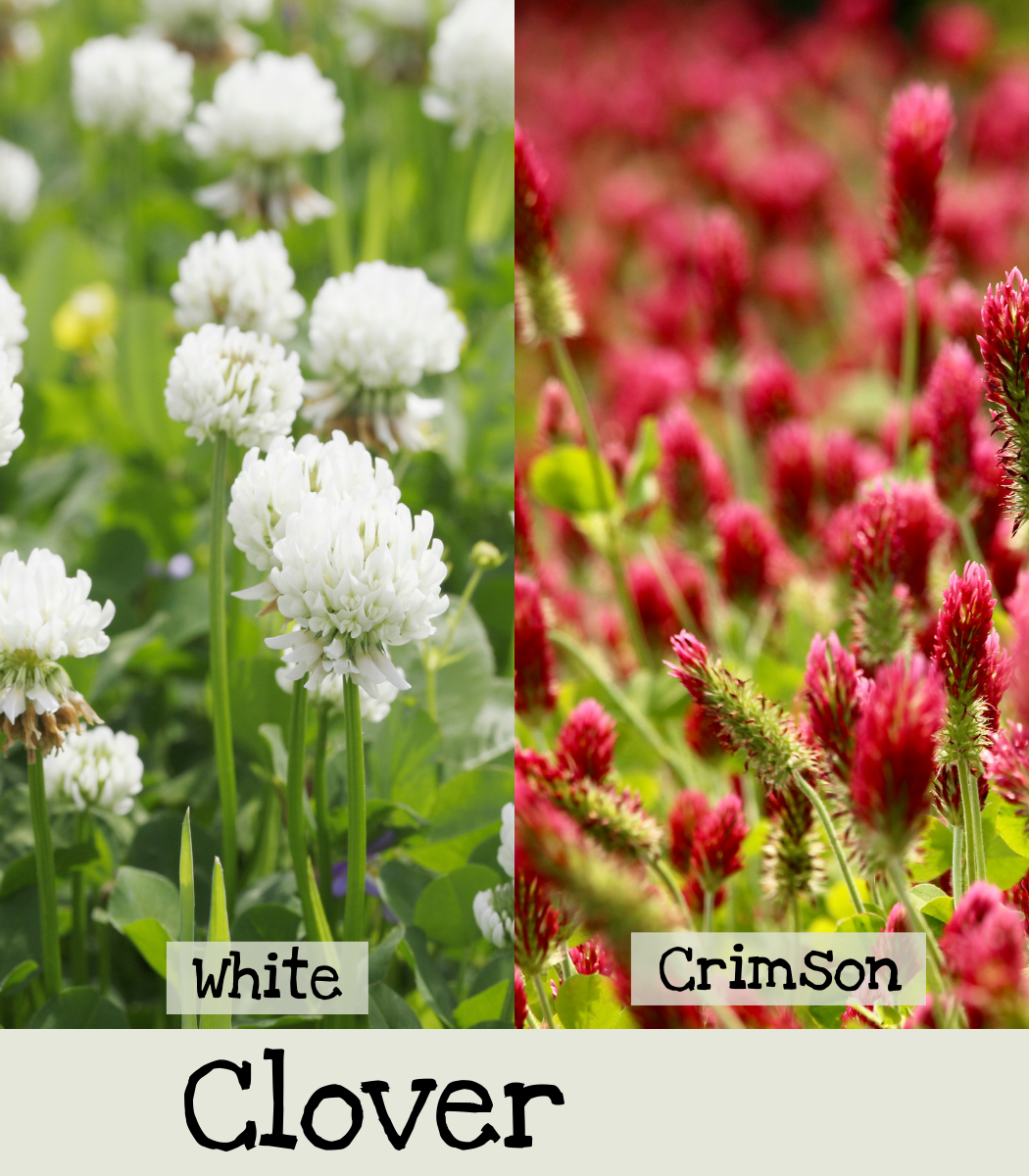
Clover
Clover was introduced to the United States in colonial times. It was mainly used as both a cover crop and a forage crop for pasture animals like cattle. Home gardeners can also use this nitrogen-fixing legume as green manure to improve soil structure and fertility. Its versatile nature also makes it a good living mulch and an attractant to beneficial pollinators like bees.
|
Crimson |
|
Trifolium incarnatum |
|
Easy |
|
Easy |
|
3-5 years if properly stored |
|
Crimson & Red clover is a short-lived perennial, usually treated as an annual. It is frost-hardy. White Clover: Perennial |
|
7-14 day |
|
55-80°F |
|
None |
|
Surface sow or lightly cover |
|
24-36” |
|
Seeds need light to germinate Full sun but tolerates partial shade |
|
90-120 days |
|
Mar, Sep |
|
Yes |
Growing Tips

When to Start
While clover can be planted from early spring to late summer, your intended purpose will determine when you plant it.
Spring: For most areas, you can sow when temperatures are between 60°F and 85°F and soil temperatures are 55+°F. (Historically, soil temperatures are 55°F starting in mid-March for Jefferson, GA)
Fall Crimson Clover: Grow zones 6 and warmer, 6-8 weeks before the first frost in your area. (Mid-September for Jefferson, GA.)
Fall White Clover: Late Summer or a minimum of 6-8 weeks before the first frost in your area.
How to Grow
Clover is relatively easy to grow. But how you choose to use it will determine when you sow it. When using it as a living mulch or for the enjoyment of the flowers, sowing in the spring is a better choice.
If the purpose is for soil improvement, such as a green manure, late summer to early fall is the ideal time to sow.
No matter what your purpose, choose a full sun area. Clover will tolerate part shade, but thrives in full sun. Remove any grass or weeds from the bed and loosen the soil. Scatter the seeds on the surface of the soil, as the seeds need light to germinate. You can use a spreader for a more even spread, but using your hand is effective too.
Red clover should be planted thickly, no matter the use. When using white clover as a living mulch (weed suppressant) or green manure, sow thickly so that it can crowd out weeds.
For spring sowing, wait until the soil temperatures are an average of 55°F. When the soil is 55°F, this is the triggering mechanism that tells the seeds it’s time to sprout. Keep an eye on the weather and adjust sowing accordingly. You don’t want a late freeze to kill newly germinated seedlings. Keep the soil moist throughout the germination process. Find your average soil temperatures.
Fall planting is done for soil improvement (green manure) and grazing for livestock. Farmers often sow clover in the fall to provide spring grazing for livestock and then terminate it to make green manure to feed summer crops. Prepare the bed by removing weeds and scatter the seeds on the soil a minimum of 6 to 8 weeks before the first frost in your area. This will allow the clover to get established before winter freezes.
You can also sow clover in the winter, but there are some things to consider. Wait until after at least 2 killing frosts. This is so that the soil temperature remains below 55°F, keeping the seeds dormant until spring. A problem with winter sowing can be birds. Birds view clover seeds as a food source. Winter sowing may not be the best option for home gardeners, as typically, clover is not planted in fields, but in smaller garden beds, and birds could eat all the seed.
Which Variety to Choose
All clover is good for attracting pollinators and is an early food source for bees coming out of hibernation.
Crimson clover is a beautiful red flower. When used as a cover crop, crimson clover is typically planted in the fall and treated as an annual. It is not as cold-hardy as white clover; as such, it isn’t as common in more northern climates. This variety doesn’t hold up as well to foot traffic and mowing; the home gardener can use this as a beautiful accent in flower beds or containers. It is a short-term perennial that may need occasional re-seeding.
White clover is a good all-purpose cover crop choice. It is ideal for living mulches and weed suppressants. As a cold-hardy perennial, it holds up well to foot traffic and mowing. It does get tall and might need mowing to keep it at a more manageable height. But it does well in most grow zones (3-10), with the most northern zones treating it as an annual.
Despite its name, red clover blooms are magenta and amethyst-colored. It is most often used as green manure and a cover crop in pastures. It can reach heights of 15 to 36 inches. The home gardener can use this as a beautiful accent in flower beds and containers. It is a short-term perennial and might need occasional re-seeding.
Microclover is a low-growing clover that grows to a height of 3-5 inches and withstands foot traffic well. Often, this is the variety that is used for clover lawns. But its low height might make it a good choice for garden paths and living mulch if you can afford the price.
How Clover ‘Fixes’ Nitrogen
Clover is a legume, and like all legumes, it has the ability to take atmospheric nitrogen and fix it into the soil. It does this through a symbiotic relationship with bacteria that infect the roots of clovers.
“Nitrogen is ‘fixed’ in clovers through a symbiotic relationship with Rhizobium bacteria that infects the plant’s roots. The plant provides energy for the bacteria, and bacteria provide the ‘machinery’ necessary to convert atmospheric nitrogen into a form available to plants.”
This is what makes clover a good cover crop in the form of living mulch or as a kind of companion plant to heavy feeders like zucchini and tomatoes.
The process of converting atmospheric nitrogen to a form that is available to plants in the soil is done through root nodules. However, the nitrogen that these nodules produce is not immediately available for nearby plants. The nodules have to decompose first in order to release the stored nitrogen into the soil. Think of it like a time-released fertilizer.
This decomposition process makes using clover as a kind of companion plant not a quick fix for soil improvement. But that is what makes clover ideal as a living mulch, as it will continually provide nitrogen over time.
This ability to fix nitrogen in the soil is what makes clover and other legumes a great choice for green manure. You get a double whammy of nitrogen from the root nodules and the green leaves once it’s all decomposed. See How to use clover as a cover crop for detailed instructions on how to make green manure.
Care
Clover requires very little care once established. While clover is drought-tolerant, it won’t spread well when conditions are dry. For the best coverage, keep the clover consistently moist.
Clover can grow 3-4 feet tall. When using it as a living mulch or as a kind of companion plant, you will want to be able to mow to keep the clover at more manageable levels. There are varieties called microclover. These microclovers reach 3-5 inches tall and might be better suited for smaller gardens, raised beds, and paths between rows that are difficult to mow.
Pest Management
Clover is mostly a pest-free plant. It does sometimes suffer from crown and stem rot. This usually occurs when conditions are wet and cool, and the clovers are overcrowded. Mowing and grazing will help encourage airflow and prevent rot.
How to use clover as a cover crop
Farmers use white clover as an inter-row ground cover for many cash crops and in orchards. Home gardeners can make use of white clover in much the same way. I’m working on getting it established as rows in my in-ground beds. Once established, it should crowd out any weeds, improve the soil by replenishing nitrogen, and keep my mulch purchases to a minimum.
When using clover as a cover crop (living mulch, weed suppressant, and green manure), remove weeds from the bed and level the soil. Sow thickly. There is a two-pronged purpose for this. One, to crowd out weeds. And two, to provide the biomass for green manure.
For use as a weed suppressant or living mulch, sow as soon as you can in spring. You want the clover to establish before weeds do.
It may be more difficult for a home gardener to use clover as a green manure, as clover can be determined to live. It might take several passes with a rototiller to fully terminate the clover.
Making Green Manure
Green manure is made from fast-growing legumes or other crops that are grown specifically for improving soil health rather than harvesting. They are grown and chopped into little pieces. Then tilled into the garden bed, where they decompose, releasing nitrogen and nutrients in the soil to increase soil health for the crop you intend to harvest.
Legumes are typically chosen for green manure as they will fix nitrogen in the soil. However, the home gardener may prefer collards, cowpeas, spinach, and mustards to clover.
Any crop, when plowed into the soil, will add additional nitrogen and other beneficial nutrients to the soil after it has fully decomposed.
1. Choose the crop.
2. Plan when you need to start it. Look for how many days are needed for maturity, and then add 4-6 weeks to that. That will give you the number of days you need to sow the green manure before you plant the crop you choose to harvest. This is why most green manures are started in late summer or early fall and then terminated before winter or early spring.
3. For maximum nitrogen benefit when using clover, mow or cut it into small pieces when the clover is flowering. (All other green manure crops should be terminated before flowering.) This is done 4-6 weeks before planting the next crop you are going to harvest. The size it is cut into matters; less than 4 inches is good, but the size of mowed grass is better. The smaller the pieces, the faster it will decompose. And it is critical that it is fully decomposed before you plant the crop you intend to harvest.
Unfinished compost can burn plants. Plus, the microorganisms that break down plant matter use nitrogen for the decomposition process. While decomposition is taking place, you are actually robbing the crop of nitrogen. You want enough time to lapse between plowing in the green manure and planting for the decomposition to finish. Only after this process is finished will the nitrogen in the soil be available for the next crop.
4. For soil improvement, immediately after mowing, till the cover crop into the ground. It may take several passes to fully terminate the clover as it spreads from runners. The idea is to get as much nitrogen into the soil as possible. If you wait, the plant browns, losing nitrogen. When the plant is still green, it has the most nitrogen; hence the term Green Manure. This step is performed 4-6 weeks before planting the next crop so that it has time to fully decompose. Only after decomposition has finished is the nitrogen available for the next crop to take up.
My personal experience
I’m working on getting it established as rows in my in-ground beds. My idea is for it to act as a living mulch and over time to improve the soil. I haven’t had the best success in terms of it crowding out weeds. I think reason is 2 pronged. I haven’t sown thickly enough or soon enough. I killed everything with cardboard and am going to try again, but in smaller sections to really give it time to spread and take over.
It is working very well in my back corner flower bed as a weed supressant. I still had to pull some weeds, but it’s taking over well. What I don’t like about this area is the clover gets tall and over shadows some of my flowers. Eventually, once the lilac bush gets bigger and is the only plant in the bed, this won’t be a problem. What might’ve work better in the interum is using a microclover.
Once established, the clover should crowd out any weeds, improve the soil by replenishing nitrogen, and keep my mulch purchases to a minimum.

Seed Saving

Isolation Distance
Clover is insect-pollinated. Clovers of the same species will cross-pollinate. But different species will NOT cross-pollinate. Example: Trifolium incarnatum (crimson clover) will not cross with Trifolium repens (white clover).
Instructions
When the flower centers turn brown and the stems begin to turn yellow, the seeds are mature and ready for harvest. Cut the heads off the plant. Let them dry in a cool, dark place. Then crush and roll the dried flower heads with your hands to dislodge the seeds. Separate the seeds from the chaff and store the seeds in a labeled paper bag in a cool, dry place.
Features
- Easy to grow
- Low-maitenance
- Drought-tolerant
- Clover is a nitrogen-fixing legume. It is good to use as a cover crop or green manure.
- Attracts bees and other pollinators.
- Ground cover
- Living mulch
- Fodder Crop for cattle, etc.
- Crimson: Heirloom. An Italian clover that is a nitrogen-fixing legume. The crimson heads attract many bees and other pollinators. When planted thickly, it makes an excellent ground cover or green manure.

The home gardener might want to consider using a microclover variety if using it for a living mulch or weed suppressant.
Determine your purpose for planting clover to know if you should plant it in the spring or fall.
You May Also Like:
Using Cover Crops to Help Grow Leeks
Companion Planting: How to use flowers to help control pests.